Embedded Artists
Contact Us Home
Corporate Products Services Support Web Shop
Products
› Board Comparison Chart
» Developer's Kits
» OEM Boards
↓ QuickStart Boards
› LPC2106 RS232
› LPC2129 CAN
› LPC2148 USB
› Prototype board
› Christmas Tree
› Color LCD Bluetooth Game
» Education Boards
» Displays
» Tools
Resources
User's Manual
QuickStart Program Development User's Guide
Schematic
Price Information
49 EUR
Buy
With a prototype board:
69 EUR
Buy
Development Tools
If you are in need for development tool support such as debugger, JTAG, and compiler, please have a look at the Development tools section.

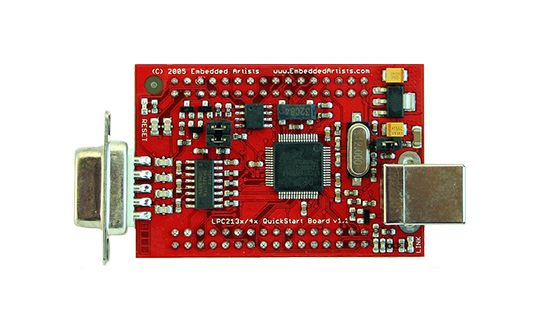
LPC2148 USB QuickStart Board

LPC2148 USB QuickStart Board (Note: This is not the correct picture of the LPC2148 board, but the board looks very similar)

Features

Embedded Artists' LPC2148 USB QuickStart Board lets you get up-and-running quickly with NXP's ARM7TDMI LPC2148 microcontroller. The small form factor board offers many unique features that ease your development.

Feature Description
Processor NXP's ARM7TDMI LPC2148 with integrated USB 2.0 device.
Program Flash 512 KB
Data Memory 32+8 KB
Clock Crystals • 12.0000 MHz crystal for maximum execution speed (5x PLL = 60 Mhz CPU clock)
• 32.768kHz RTC crystal
Dimensions 59 x 39.5 mm
Power On-board low-dropout voltage and reset generation
• Generates +3.3V from a +5V supply
• +3.3V available for external circuits, up to 300 mA
• Power supply: 5 VDC
• or via USB connector (very practical since no external power supply is needed)
Connectors • Dual 2x16 pins I/O connectors
• Signals available on expansion connector
• RS232, DSUB-9 (ESD/EMI protected)
• USB connector (USB 2.0 Device)
Other • 2 Kbit I2C E2PROM for storing non-volatile parameters
• Simple and automatic program download (ISP) via serial channel. Circuit that automatically controls the bootloader from RS232 channel
• Four layer PCB (FR-4 material) for best noise immunity
• Both UART #0 and #1 connected

Software

In order to ease the development of application programs Embedded Artists' QuickStart Boards are delivered with a lot of software/sample applications.

  • Pre-emptive Real-Time Operating System (RTOS) - the RTOS is delivered as a binary package together with some sample applications that illustrate different functionalities of the RTOS.
  • Analog to Digital Converter - Demonstrates how to convert the analog inputs into digital values (for processors with built-in ADC).
  • Code Protection - Demonstrates how to enable the code protection functionality (for processors with built-in code protection functionality).
  • In-Application Programming - Demonstrates how to invoke the IAP functionality from an application program (to program the internal FLASH memory).
  • UART - Demonstrates how to use the UART in an irq and a polled implementation (i.e., with or without using interrupts). Includes a general print number function.
  • Polled I2C - Demonstrates how to use the I2C as a master in polled mode (i.e., without interrupts). Reading and writing to an i2c-eeprom is used as sample application.
  • SPI - Demonstrates how to use the SPI as a master in both a polled and interrupt implementation.
  • SWI - Demonstrates how to use SWI interrupt (software interrupts) and how to create a customer SWI handler.
  • FIQ Handler - Demonstrates how to create a customer FIQ handler.
  • IRQ Handler in SYS Mode - Demonstrates how to create an IRQ handler that execute interrupt handlers in SYSTEM mode, instead of IRQ mode.
  • PWM Examples - Demonstrates how to vary the frequency of a PWM signal and how to vary the duty cycle of a PWM signal.
  • Timer Interrupt - Demonstrates how to use a timer (in interrupt mode) as system time counter and how to register timer callback functions.
  • Timer Delay - Demonstrates how a timer can be used to implement exact (polled and irq) delays.
  • Power Save Mode - Demonstrates how the idle mode can be used to save power.
  • Power Down Mode - Demonstrates how the power down mode (lowest power mode) can be used to save power.
  • Real-Time Clock - Demonstrates how the real-time clock can be used.
  • Watchdog - Demonstrates how the watchdog can be used.

QuickStart Build Environment
In order to be able to build the sample applications the QuickStart Boards are delivered with Embedded Artists' build environment. It is based on GCC v3.4.3 + newlib as the compiler.

Advantages

Embedded Artists' LPC2148 QuickStart Board is not just another prototyping board. The many unique features and the extensive support package provided gives you a head start before your competitors.

  • Get up-and-running quickly
    • Start developing on day 1
    • Development environment included (compiler, linker, make, editor, etc.) – based on GCC
    • Many sample applications included
    • Extensive documentation
    • Rowleys CrossWorks included (30 day evaluation version)
    • IAR Embedded Workbench KickStart Compiler included (32 KByte limited)
  • Real-time operating system (RTOS) included
  • Board support package (BSP) included
  • Minimize design problems by using pre-designed hardware boards
  • Simple and automatic program download (ISP)

Low Cost

The LPC2148 QuickStart Board is very low cost and can be used for prototyping/development as well as for OEM production. Modifications for OEM production can easily be done for volume customers. Contact Embedded Artists for further information about design and production services. You will likely be surprised at our competitive prices!

Bulk boards (10 or 100 board packages) can be delivered without pin rows soldered for easy integration with original equipment.


© Embedded Artists Legal Information Privacy Statement The Art of Embedded Systems Development - made Easy ™