
LOADING
- Perfect for experiments and prototyping
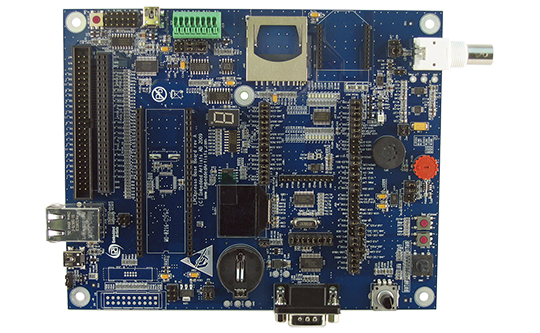
The LPCXpresso Base board makes it possible for you to get started with experiments and prototyping immediately.
| Common features | |
|---|---|
| Socket for LPCXpresso and mbed module | |
| 50 pin expansion dual row pin list connector (male, 100mil pitch) for simple connection external designs and to a logic analyzer | |
| 50 pin expansion dual row header connector (female, 100mil pitch) for simple connection to breadboard | |
| Battery powering (small coin battery) | |
| USB interface | |
| Reset pushbutton | |
| Digital IO | |
|---|---|
| RGB-LED (can be PWM controlled) | |
| 5-key joystick switch | |
| 2 pushbuttons, one for activating bootloader | |
| Rotary switch with quadrature encoding (timer capture) | |
| Temperature sensor with PWM output (timer capture) | |
| Analog IO | |
|---|---|
| Trimming potentiometer input (analog input) | |
| PWM to analog LP-filtering (PWM output and analog input) | |
| Speaker output (PWM output) | |
| Oscilloscope probe inout stage | |
| Serial bus - SPI | |
|---|---|
| Shift register driving 7-segment LED | |
| SD/MMC memory card interface | |
| Dataflash SPI-NOR flash | |
| Serial bus - I2C | |
|---|---|
| PCA9532 port expander connected to 16 LEDs | |
| 8kbit E2PROM | |
| MMA7455L accelerometer with I2C interface | |
| Light sensor | |
| Serial bus - I2C/SPI shared | |
|---|---|
| SC16IS752 - I2C/SPI to 2xUART bridge; connected to RS232 full-modem interface and one expansion UART | |
| 96x64 pixel white OLED (alternative I2C/SPI interface) | |
| Serial bus - UART | |
|---|---|
| USB-to-serial bridge, with automatic ISP activation | |
| RS422/485 interface | |
| Interface socket for XBee RF-module | |
| Specific LPC1768 (incl mbed) support | |
|---|---|
| CAN bus interface (can be simulated with LPCXpresso LPC1114/LPC1343) | |
| Ethernet RJ45 connector with integrated magnetic | |
| Dimensions | |
|---|---|
| 150 x 180 mm | |
| Power | |
|---|---|
| Powered via USB (+5V) | |
| Flyers and specifications | |
|---|---|
| LPCXpresso Baseboard schematics | |
| LPCXpresso boards pinning | |
| Documentation and guides | |
|---|---|
| LPCXpresso BaseBoard User's Guide | |
| Software resources | |
|---|---|
| LPCXpresso Baseboard sample applications | |